
California is the stress test for the free Law Lookup: the dataset records ten California laws, more than any other jurisdiction it tracks. Eight are in force, one is proposed, and one is repealed. Read in status order, the ten cards tell the whole story of how deepfake law grew up. This is information, not legal advice; the official text of every law sits in the California Legislative Information database when you need the last word.
1. Two laws make you label
SB 942, the California AI Transparency Act, is in force since August 2, 2026 and requires labeling; the dataset records it against large generative AI providers, with a threshold of 1,000,000 users in the current text. AB 2355 (2024), the Defending Democracy from Deceptive Deepfake Videos Act, requires AI disclosure in political ads. If your work touches voters or ships AI output at scale, these are your two cards.
2. Two laws make you ask first
Consent is the other lever. AB 1836 (2024) covers deceased personalities' digital replicas and records consent as required. AB 2602 (2024) does the same for performer contracts and digital replicas of living artists. Both are in force since January 1, 2025. Our California vs Texas comparison shows how different the neighbouring playbook looks.
3. Elections got three cards, one of them history
AB 2839 (2024), the Protecting Democracy from Disinformation Act, has been in force since September 17, 2024 and targets materially deceptive election deepfakes. AB 2655 (2024) puts duties on large online platforms to remove deceptive election content. And AB 730 (2019), California's first election deepfake ban, sits on its card as repealed, kept because it explains where the newer laws came from.
4. Two cards protect minors
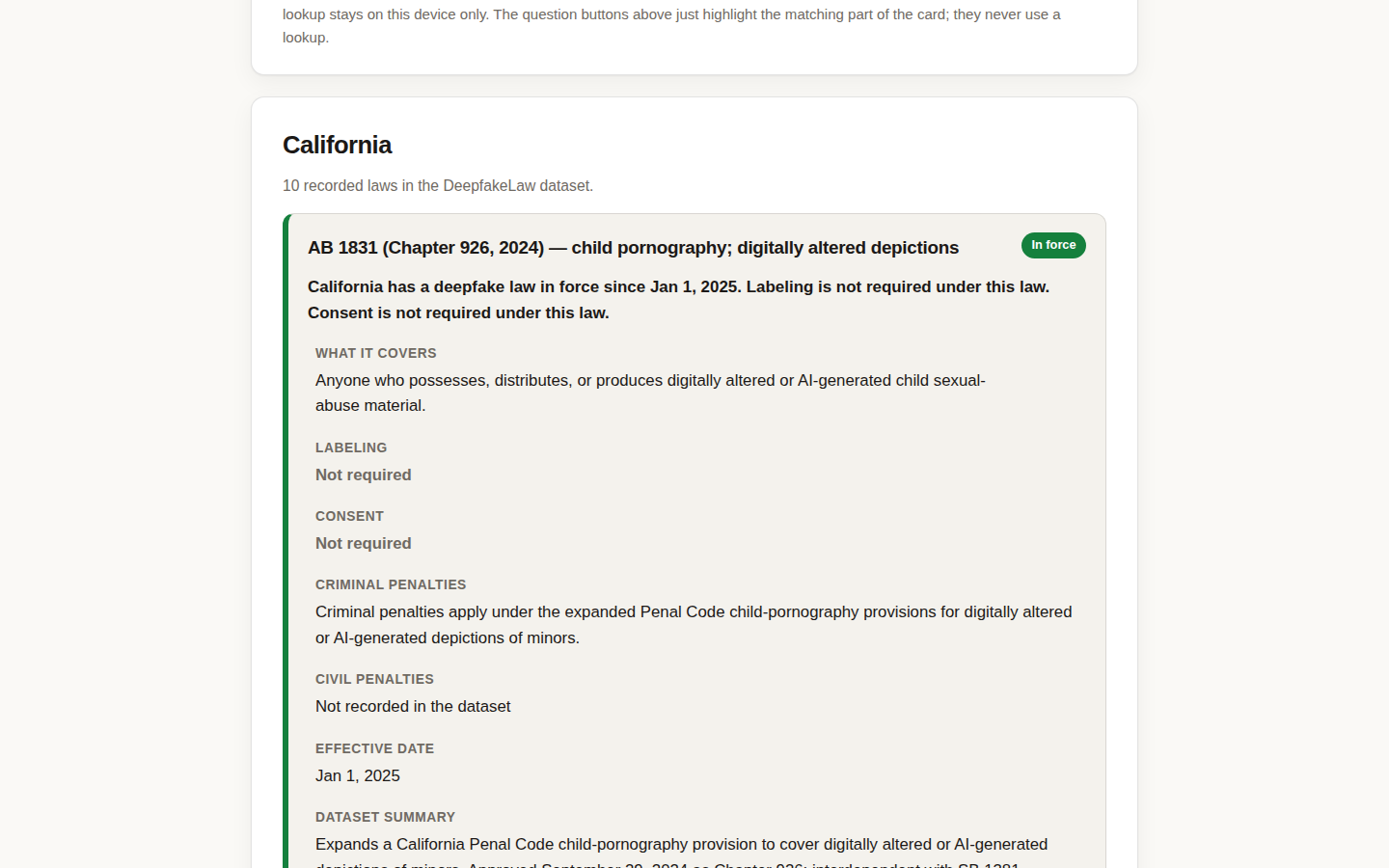
AB 1831 (Chapter 926, 2024) and SB 1381 (Chapter 929, 2024) both expand California Penal Code child-pornography provisions to digitally altered and AI-generated depictions of minors. Both in force since January 1, 2025, neither requires labeling or consent; they are criminal law, plain and simple.
5. One card is still moving
SB 1000 (2026) is recorded as proposed: amendments to the AI Transparency Act that would remove the 1,000,000-user threshold and carry forward the $5,000-per-violation civil penalty structure the dataset records for the Act. The dataset summary notes it passed both chambers and was presented to the Governor on September 2, 2026, unsigned as of the dataset's September verification. Proposed means not law, and the card says so.
6. How to use a ten-card state
Filter by your activity, not by the headline: publishing, labeling, likeness, elections. Then check the status line and the effective date before you rely on anything, and re-run the Law Lookup when a card changes. The site's AI disclosure requirements guide covers the labeling side across states, and teams shipping AI features can also run the ShipSafe Filter on our sister site before a model goes live. New to the tool? The short explainer covers how to read any card in the set.