
Deepfake law is usually described as a patchwork. Patchworks can be counted. The national policy tracker that wins this site's state queries puts the current tally at 48 states with enacted laws on deepfakes depicting explicit sexual content and 33 states with laws on deepfakes in political communications, as of October 22, 2026, with most of the political laws applying inside a set window before an election and carrying disclosure exceptions. Our own database, the one behind the Recitation Reel Maker, holds 91 laws: 61 US state entries, 25 countries, 3 EU instruments and 2 federal laws, 77 of them in force.
Why the two counts differ
They measure different things. The tracker counts states that have enacted at least one qualifying law in each category. Our database counts laws themselves, and states stack them: a single state can hold an election statute, a nonconsensual-imagery statute and a nudification-app ban at once, which is how Minnesota alone fills three records here. Neither count is wrong. Together they say the quiet part: coverage is broad (48 of 50 states on explicit content) and depth is uneven (a third of states still lack a political-communications law a week before a midterm).
What the laws actually require
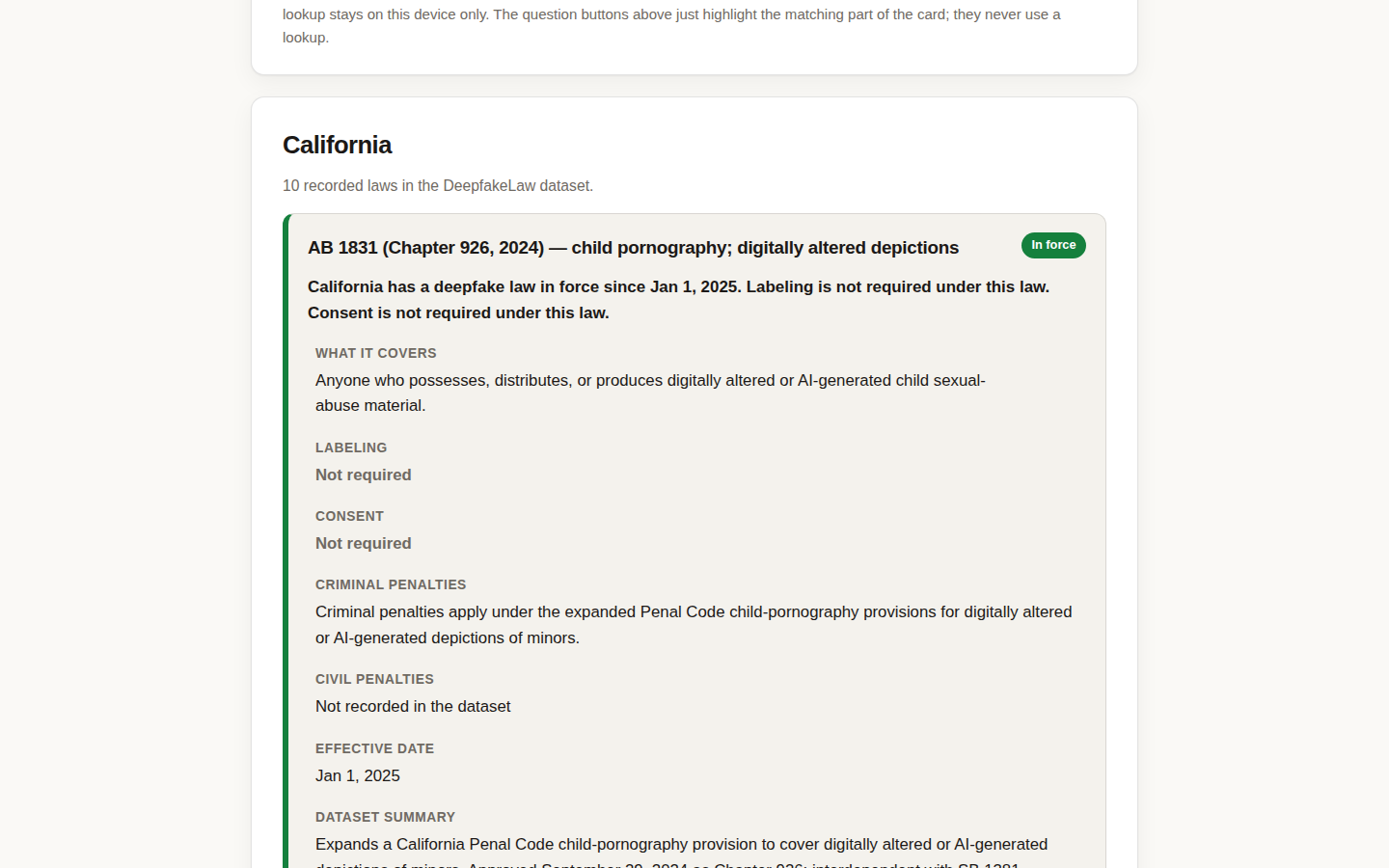
Across our 91 records, 44 require consent for the depiction and 27 require labeling or disclosure of AI content. Criminal penalties attach to most of the explicit-content statutes; the election statutes lean on disclosure duties and civil actions. The proposed pile is not small either: 10 of our 91 records are still proposals, which is the pipeline next year's counts will be made of.
How to use the count
As a map, not a verdict. If you make or distribute synthetic media, the operative question is never how many states have laws; it is what your state requires, which the Recitation Reel Maker answers record by record with the official text attached. But when someone tells you deepfake law is two states and a press release, the count is the correction: 48, 33, and still being written.